
What the new Equimundo report tells us about the future of men’s health in Australia
Our sector is being asked to respond to complex, national issues — suicide prevention, isolation, fatherhood, violence prevention, help-seeking, online harms, workplace culture and chronic disease — through short-term, fragmented and often under-resourced models. That is not sustainable.
The new Equimundo and Dalberg Rapid Landscape Assessment: Caring Masculinities in Australia should be essential reading for anyone working in men’s health.
Not just because it talks about men and boys, or because it gives us another set of statistics about the challenges men face. Its real value is that it holds up a mirror to the operating environment our members and partner organisations are trying to work in every day.
And from where I sit, both as someone involved in the national men’s health ecosystem through Australian Men's Health Forum and in my role at Mentoring Men, what it reflects is very familiar.
Australia is not short of committed organisations working with men and boys. We are not short of passion, innovation, community trust or frontline wisdom. What we are short of is the infrastructure to connect, fund, evaluate and scale that work.
That is the issue I hear from our members and see directly in practice: organisations are being asked to respond to complex national challenges — suicide, loneliness, fatherhood, help-seeking, online harms, workplace culture, chronic disease, relationship breakdown, violence prevention and community disconnection — through funding models that are too often short-term, fragmented and under-resourced.
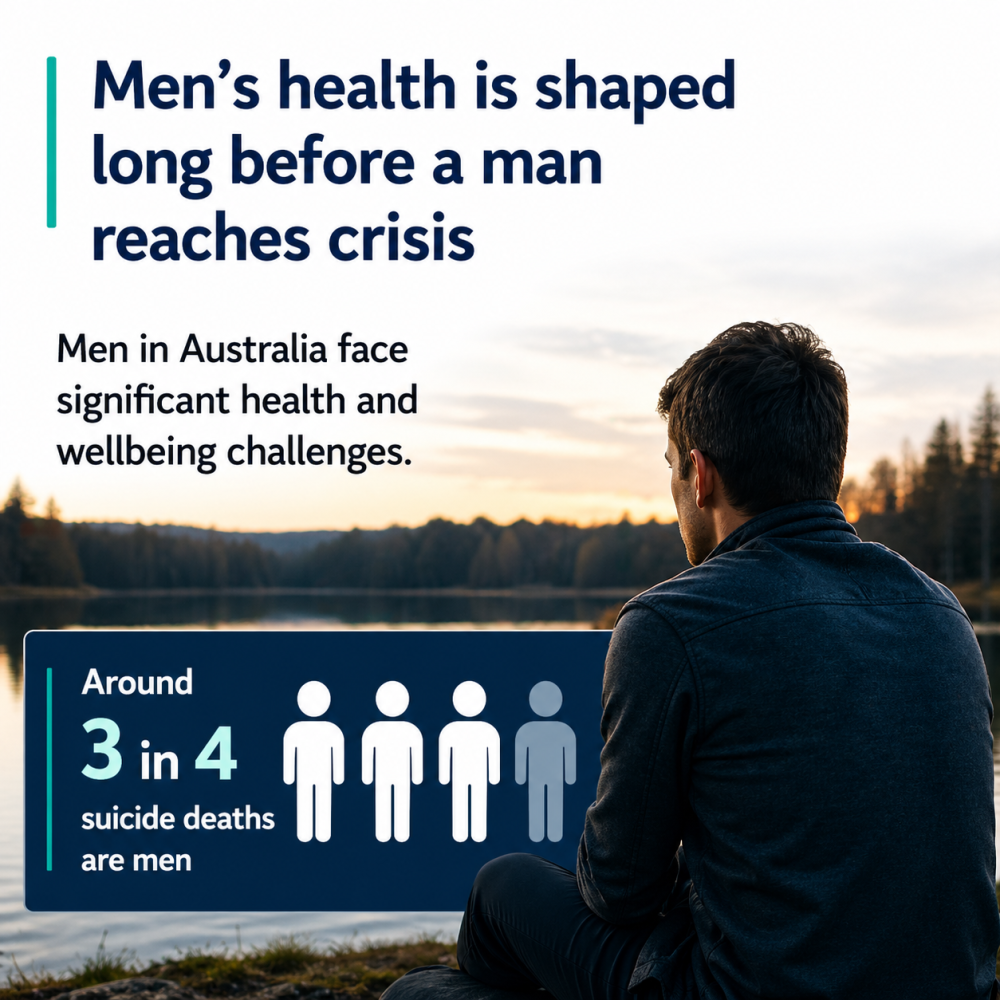
The report reinforces what the men’s health sector already knows. Men and boys in Australia continue to face significant health and wellbeing challenges. Men account for around three quarters of suicide deaths, many men are socially isolated, and men seek professional mental health support at lower rates than women. The report also highlights that First Nations men, rural and remote men, LGBTQI+ people and men facing socio-economic disadvantage often experience even poorer outcomes.
But the deeper value of this report is that it does not treat these outcomes as individual failings. It looks at the systems, norms and settings that shape men’s lives: families, workplaces, schools, online spaces, local communities, health services and care systems.
That matters deeply to our members.
Because men’s health does not begin and end in a clinical setting. It is shaped by whether a man has someone he can call when things are falling apart. Whether a father feels welcomed into a service. Whether a young man has a healthier alternative to what he is seeing online. Whether a workplace allows men to care. Whether a community organisation has the resources to reach a man before he reaches crisis point.
At Mentoring Men, I see this every day. Men do not always come to us with a neat “mental health issue”. They come with relationship stress, separation, loneliness, parenting challenges, workplace pressure, grief, shame, identity questions, financial stress, or simply the sense that they have no one to talk to. The health outcome might show up later, but the risk factors are often social, relational and structural.
That is why this report is so important.
The report recognises that civil society organisations are the engine of direct engagement with men and boys, delivering programs in schools, communities and service systems. It also recognises the role of community-based models in building social connection, alongside counselling, mental health support, men’s behaviour change programs, research, training and advocacy.
For our members, that recognition matters. But recognition alone is not enough.
The report shows that the problem is not a lack of effort. The problem is a lack of system infrastructure.
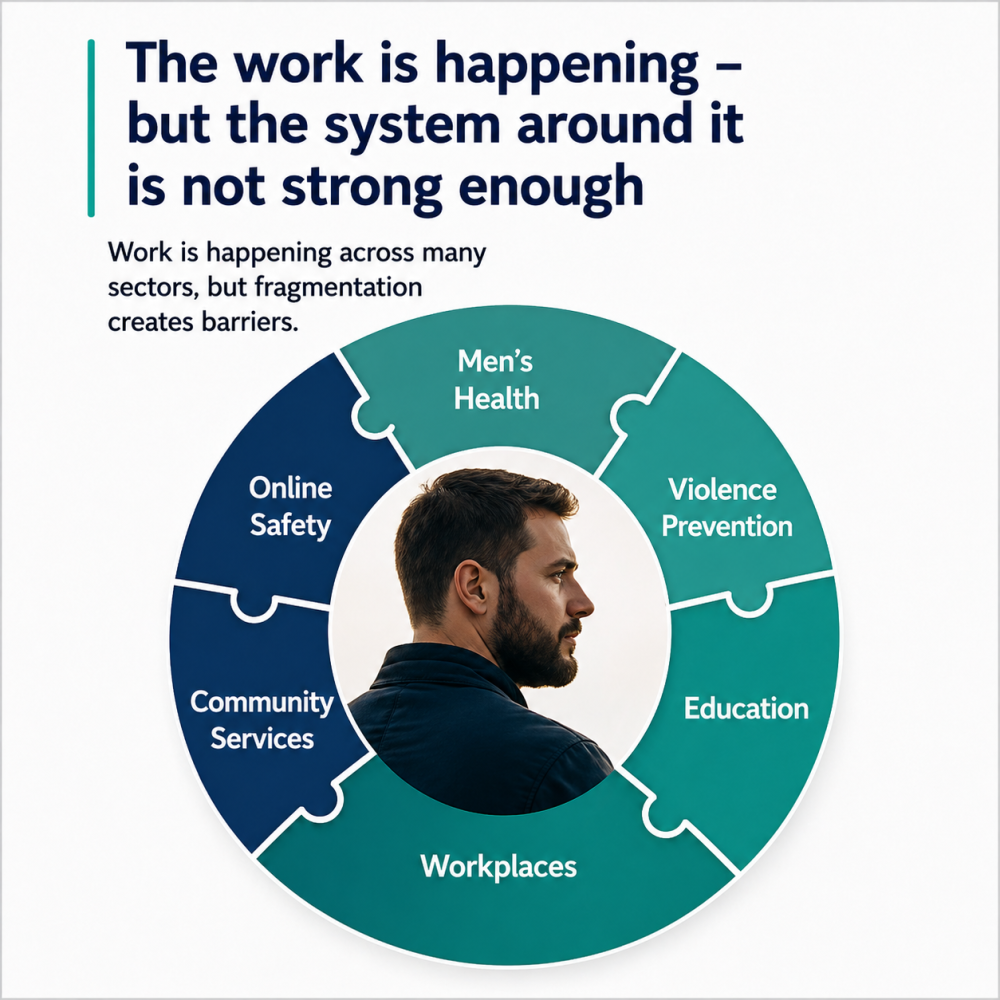
Work is happening across men’s health, violence prevention, fatherhood, education, workplaces, online safety and community services — but these areas are often funded, measured and governed separately. The report identifies fragmentation across and within sectors, and highlights the need for clearer entry points, stronger coordination and shared learning.
This fragmentation has real consequences. I hear it from members who are doing extraordinary work but constantly having to translate themselves into different funding languages. One grant wants suicide prevention. Another wants family wellbeing. Another wants social connection. Another wants violence prevention. Another wants workplace mental health.
But in the life of a man, these things are not separate.
The man who is isolated may also be a father. The father may be under pressure at work. The worker may be struggling with his mental health. The young man online may be searching for identity, belonging and guidance. The man experiencing relationship breakdown may be at heightened risk of crisis. The community organisation supporting him may be doing prevention, connection, mental health and family wellbeing all at once — but only funded to describe one part of that work.
That is a business problem for our sector, not just a policy problem.
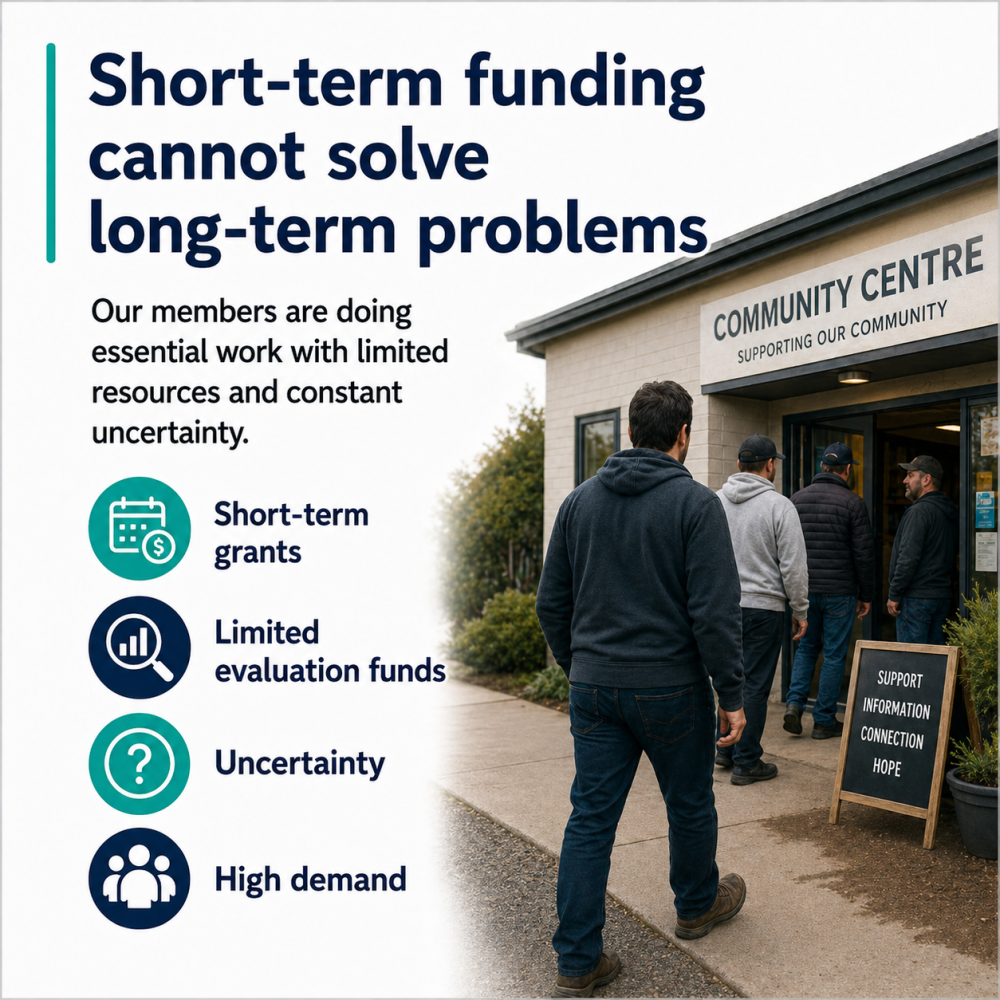
Many of our members are small or medium-sized organisations deeply embedded in community. They are trusted by men who may never walk through the door of a mainstream service. They reach people through sheds, mentoring, peer support, sport, fatherhood, workplaces, cultural networks, local groups and informal relationships.
But too often they are expected to operate on short-term grants, limited evaluation budgets, volunteer labour and constant funding uncertainty.
They are asked to prove impact, build partnerships, collect data, retain staff, meet compliance requirements and scale delivery — often without the core funding or infrastructure to do so.
I feel this directly in my role at Mentoring Men. We know the value of trusted, preventative, relationship-based work. We know what it means when a man has someone beside him before crisis hits. But we also know how difficult it is to fund prevention, especially when the strongest outcomes are often the things that do not happen: the crisis avoided, the isolation reduced, the relationship repaired, the help sought earlier.
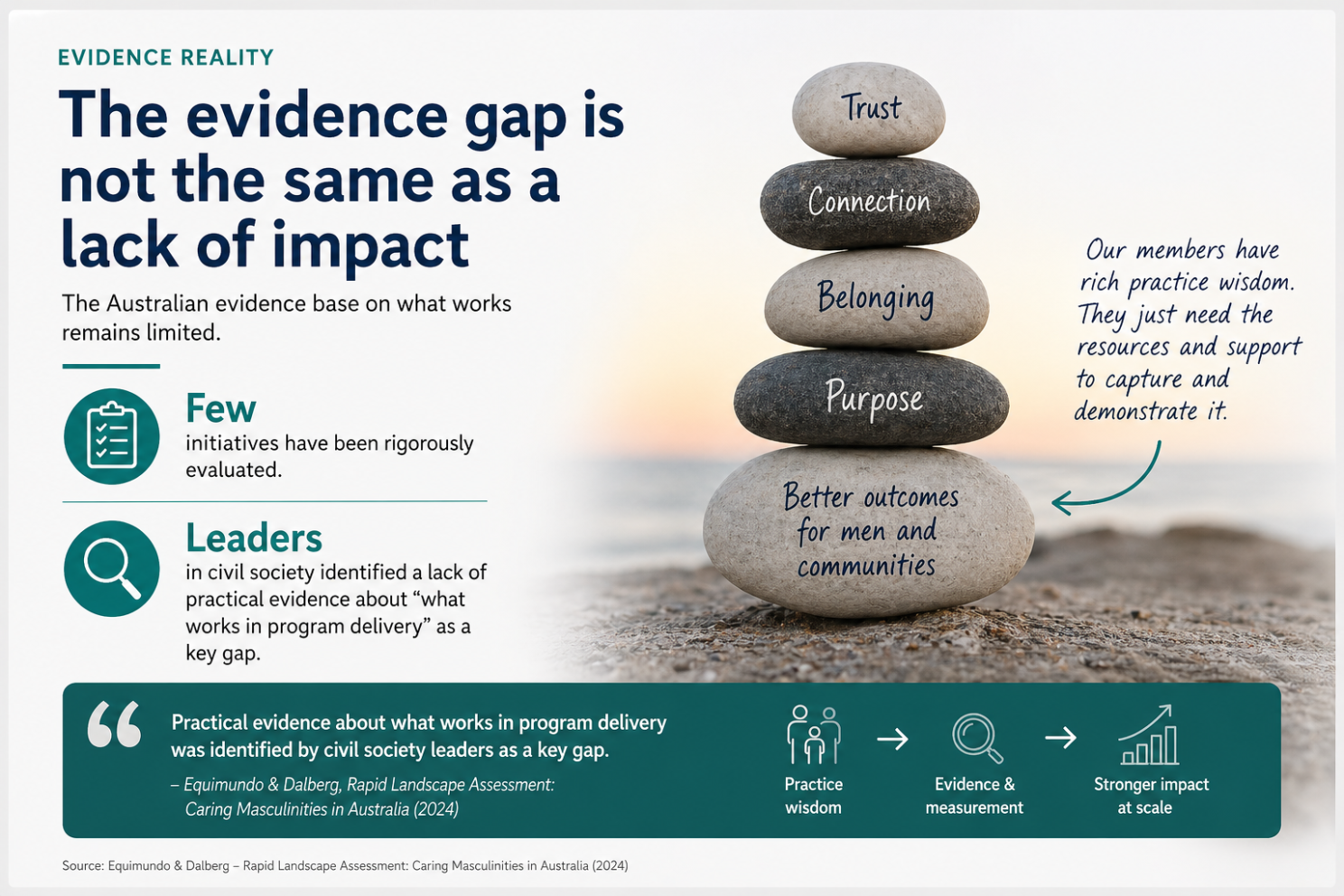
The report also makes an important point about evidence. It states that the Australian evidence base on what works remains limited, with only a few initiatives rigorously evaluated, and that many civil society leaders identified practical evidence about what works in program delivery as a key gap.
We need to be very careful how we interpret that. It does not mean the work is not working. It means the sector has not been properly resourced to demonstrate what works.
Our members hold enormous practice wisdom: how to build trust with isolated men, how to engage fathers, how to support men in rural communities, how to create safe peer spaces, how to work with men who do not use the language of mental health, how to reach men through activity, purpose and connection.
But practice wisdom does not automatically become evidence. It needs time, money, partnerships, evaluation tools and shared outcomes. Without that, organisations are left trying to prove their value program by program, grant by grant, often with measures that do not fully capture what they actually do.
The report also identifies major data gaps in areas central to men’s lives: relationships, online behaviour, violence perpetration, political engagement, men’s experiences of victimisation, help-seeking, and what men are seeking from dating and relationships.
As a national peak body, AMHF helps build the evidence infrastructure our sector needs. That means shared outcomes, common language, practical evaluation tools, member-led research partnerships, and better ways of translating frontline knowledge into policy and funding decisions.
We also need to talk honestly about funding.
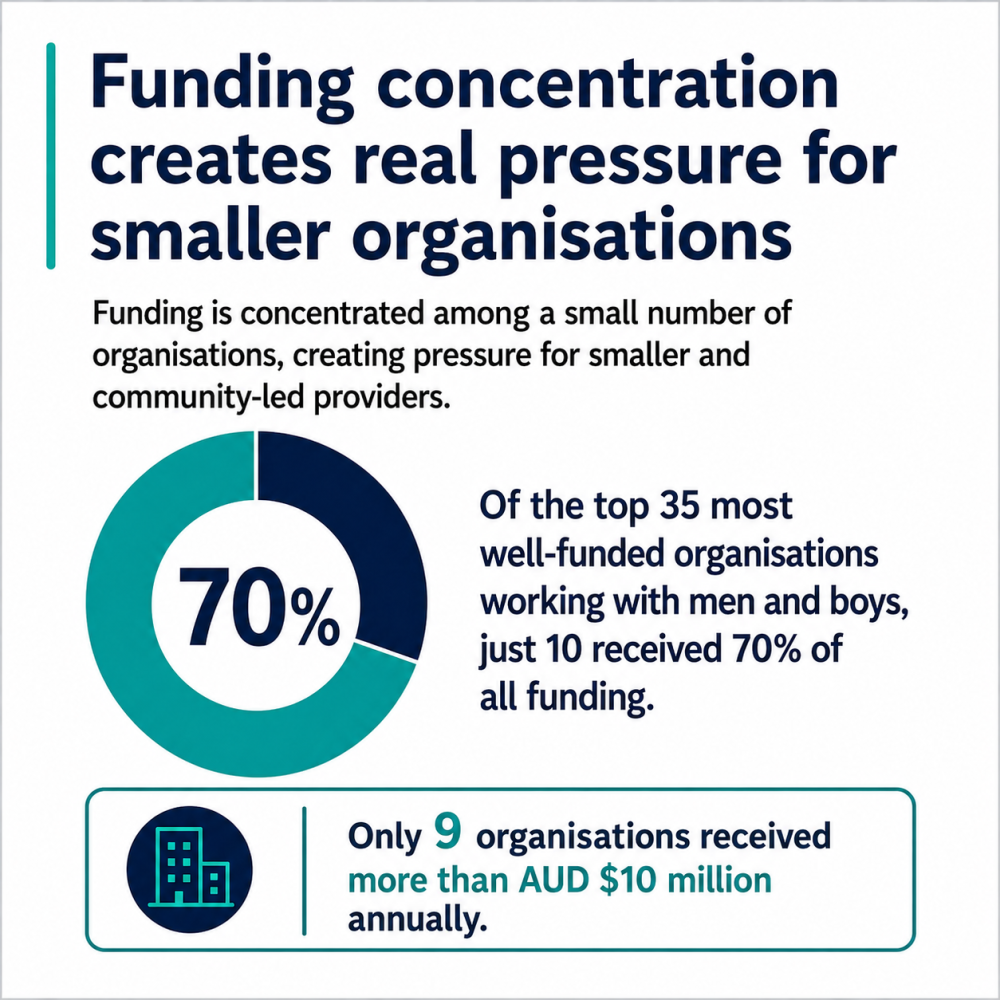
The report notes that funding in this space largely comes from government and is concentrated among organisations focused on men’s health, men’s behaviour change and primary prevention of gender-based violence. Of the top 35 most well-funded organisations working with men and boys, just 10 received 70% of all funding, and only nine organisations with a substantial focus on men and boys received more than AUD 10 million annually.
That concentration matters. It helps explain why many smaller and community-led organisations feel like they are constantly fighting for oxygen, even when they are close to the men and communities that systems most want to reach.
Short-term project funding also works against collaboration. It can unintentionally push organisations into competition with each other, even when the issues they are working on are connected. The report names this directly, noting that funding competition can drive unnecessary tension between organisations approaching the work from different entry points, such as violence prevention and men’s health.
From my perspective, that is one of the most important points in the report.
We cannot afford a false divide between supporting men’s wellbeing and building safer, more equitable communities. These goals are connected. Men who are more connected, supported, emotionally literate and accountable are better for themselves, their families, their workplaces and their communities.
That is not about blaming men. It is about investing in the conditions that help men thrive and reduce harm.
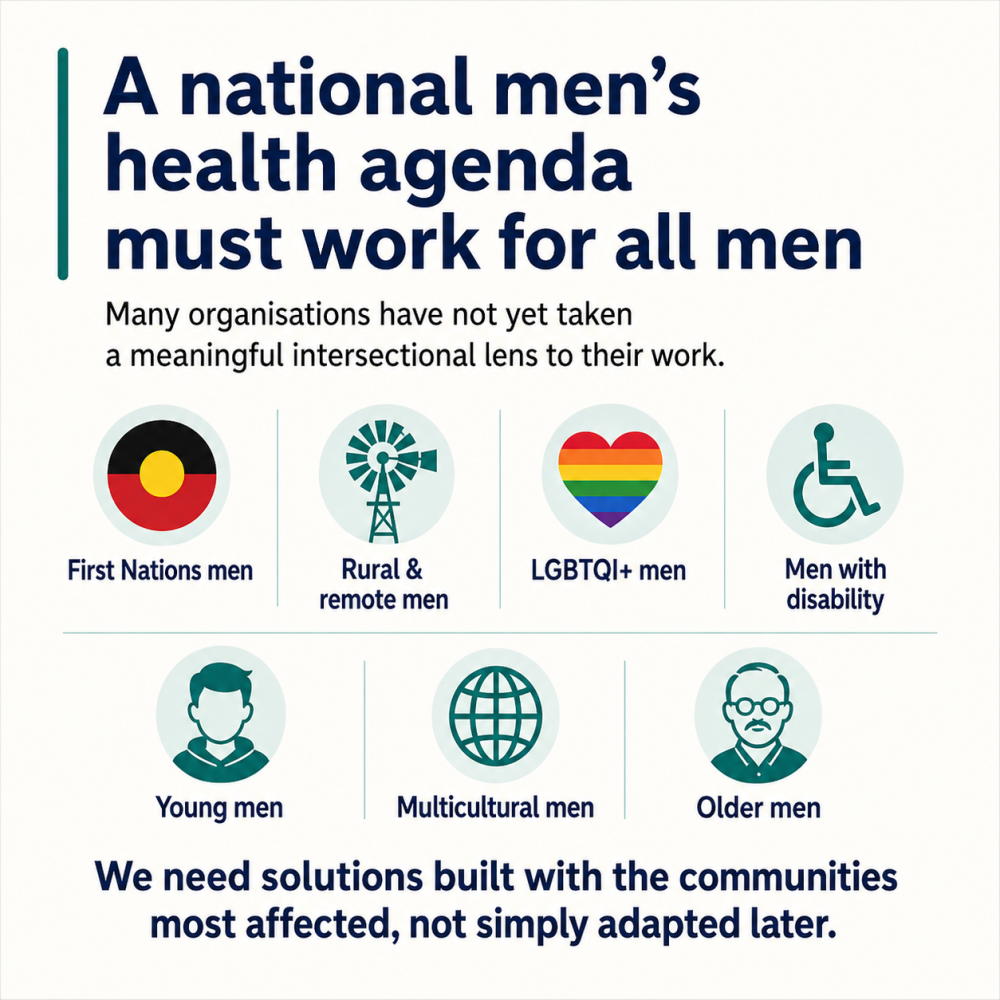
The report also challenges us on intersectionality. It notes that many organisations have not yet taken a meaningful intersectional lens to their work, often because of resource constraints. It also highlights that First Nations-led, LGBTQI+ and multicultural work can remain siloed from the broader ecosystem. First Nations experts consulted for the report called for stronger commitments to tackling overlapping systems of oppression, more equitable partnerships, shared funding and platforms, and learning from First Nations-led work rather than retrofitting mainstream models onto communities.
As a national peak body, we need to take that seriously.
A men’s health agenda that does not work for First Nations men, rural and remote men, men with disability, LGBTQI+ men, multicultural communities, young men, older men and fathers in different family structures is not a national agenda.
This is not about adding “diversity” at the end of a strategy. It is about recognising that men do not experience health, care, fatherhood, risk or help-seeking in the same way. If we want national solutions, we need to build them with the communities most affected, not simply adapt them later.
One of the strongest opportunities identified in the report is fatherhood and care.
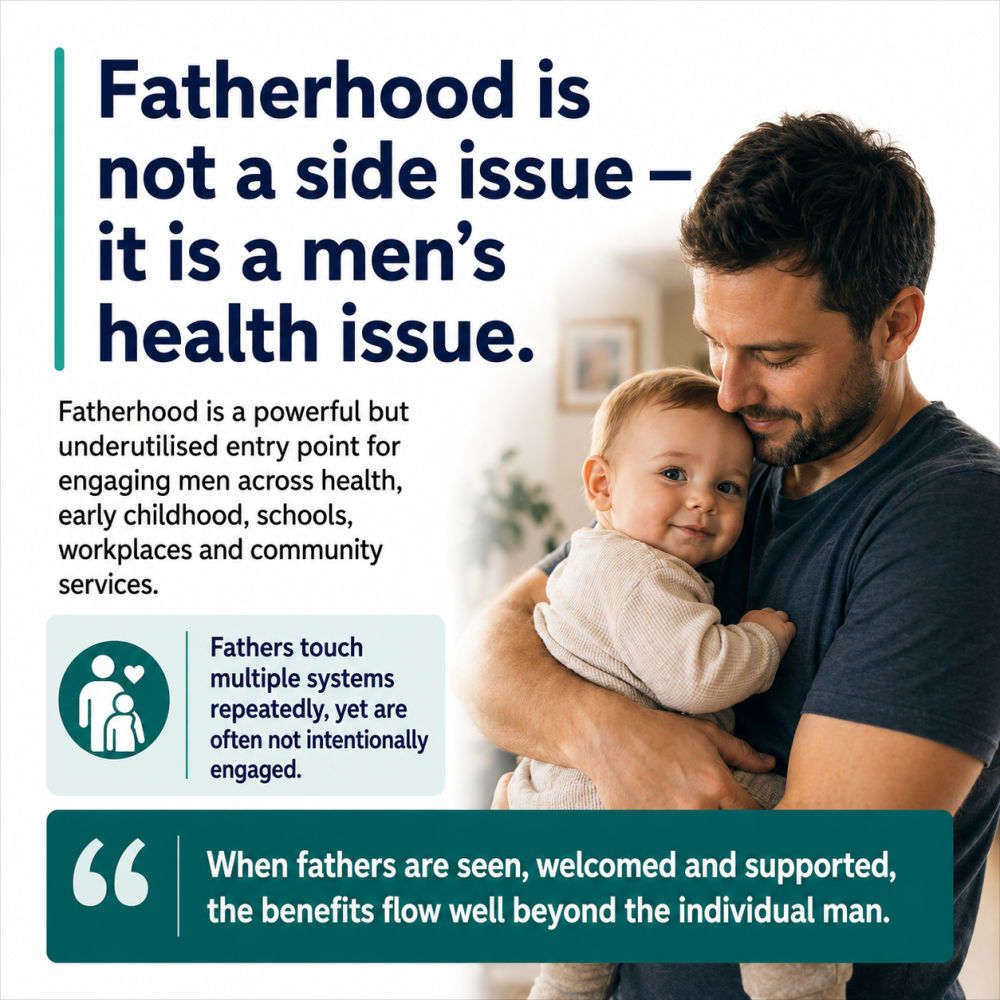
The report describes fatherhood as a powerful but underutilised entry point for engaging men across health, early childhood, schools, workplaces and community services. Fathers are one of the few groups who touch multiple systems repeatedly, yet those systems often do not intentionally engage them.
This part of the report feels especially personal to me.
As a new father to a three-month-old baby boy, I am experiencing in real time how deeply fatherhood changes a man’s life. It changes your identity, your priorities, your relationships, your sleep, your sense of responsibility, and the way you think about the future. It is one of the most profound transitions a man can go through.
And yet, even in that transition, it is easy to see how systems can still treat fathers as secondary.
Too often, the focus is understandably and necessarily on mother and baby — but fathers are also adjusting, learning, worrying, bonding, struggling, growing and trying to work out who they are becoming. If we miss fathers at that point, we miss one of the most powerful opportunities to support men’s mental health, strengthen families, and model healthier forms of care and connection.
This is exactly where our sector can lead.
Father-inclusive practice is not only about parenting. It is about men’s mental health, children’s wellbeing, family relationships, prevention, connection and care. When fathers are seen, welcomed and supported, the benefits flow well beyond the individual man.
For me, fatherhood has made this work feel even more urgent. Because when we talk about supporting men and boys, we are also talking about the kind of fathers, partners, friends, sons and community members we are helping men become.
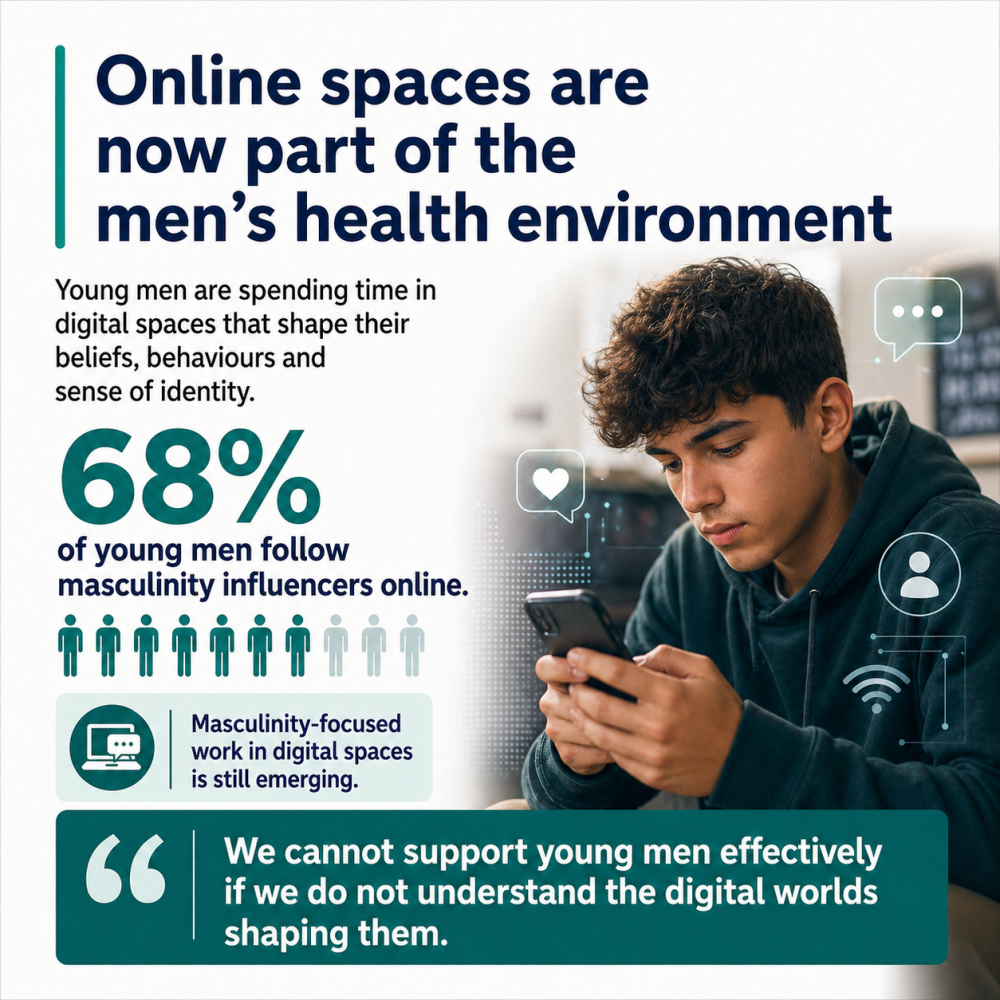
The same is true for online harms. The report highlights that 68% of young men follow masculinity influencers online, and that masculinity-focused work in digital spaces is still emerging.
For our members working with boys and young men, this is now part of the health environment. Online spaces shape identity, relationships, help-seeking, body image, attitudes to women, risk-taking and belonging. We cannot support young men effectively if we do not understand the digital worlds that are shaping them.
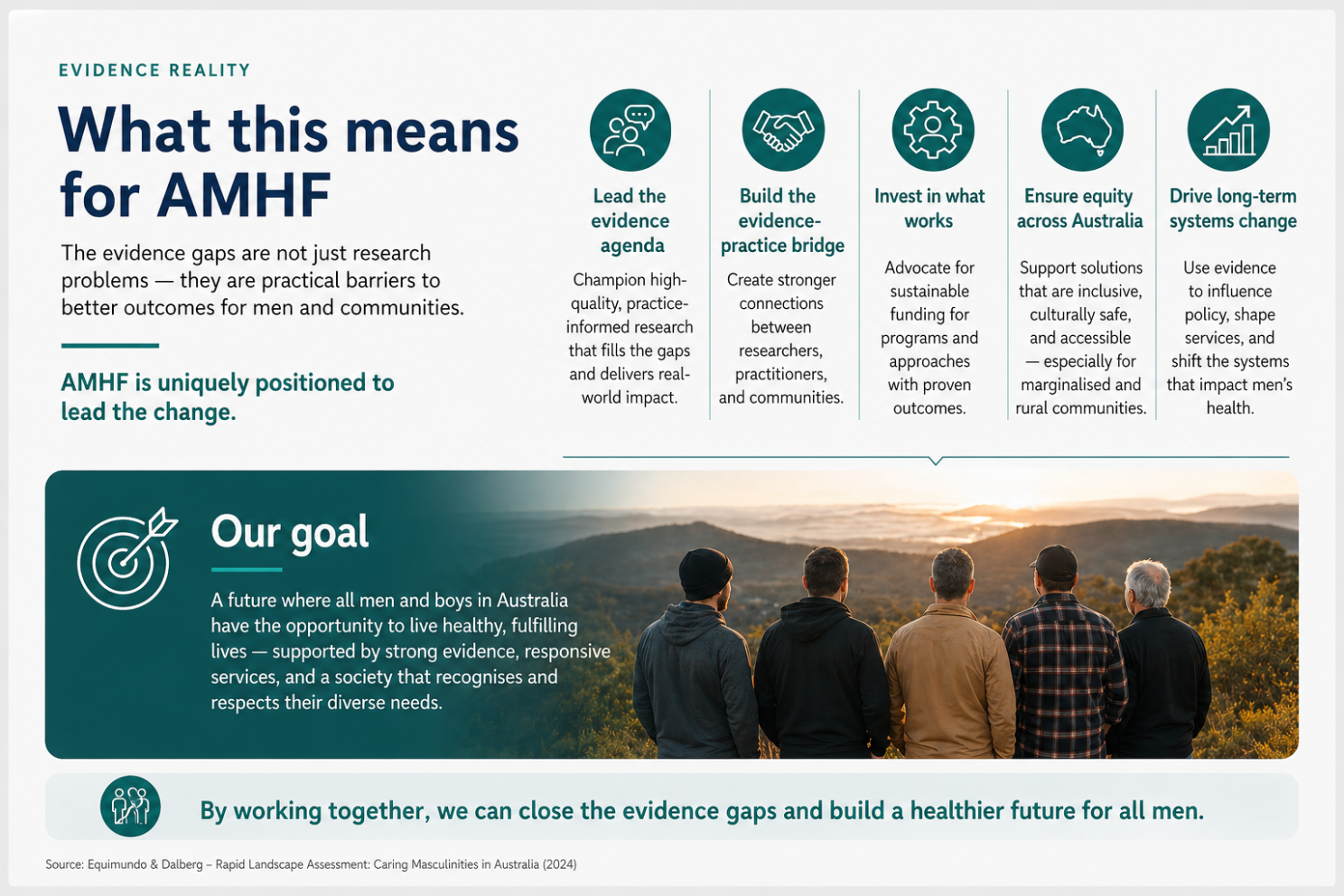
So where does this leave AMHF's members?
For me, the report points to five clear priorities.
First, we need stronger national coordination. The report highlights fragmentation, competition and the need for shared learning. AMHF can help bring together men’s health, fatherhood, mentoring, suicide prevention, community connection, Aboriginal community-controlled organisations, LGBTQI+ services, rural and regional services, violence prevention partners and researchers. But we can't do it on a shoestring budget.
Second, we need a shared evidence agenda. Our members need practical ways to capture outcomes that matter: connection, help-seeking, father engagement, reduced isolation, improved service access, wellbeing, referral pathways, cultural safety, workplace change and prevention outcomes.
Third, we need funding reform. That means multi-year funding, core operational funding, funded evaluation, support for small and community-led organisations, and funding models that reward collaboration rather than competition.
Fourth, we need to help the sector speak clearly about healthy and caring masculinities. This language must be practical and grounded in men’s health. Care, connection, responsibility, help-seeking and healthy relationships are not abstract concepts. They are protective factors.
Finally, we need to position men’s health as a bridge between sectors. Men’s health connects to suicide prevention, family wellbeing, violence prevention, workplace change, online safety, fatherhood, community connection and gender equality. AMHF’s role is to help make those connections visible and actionable.
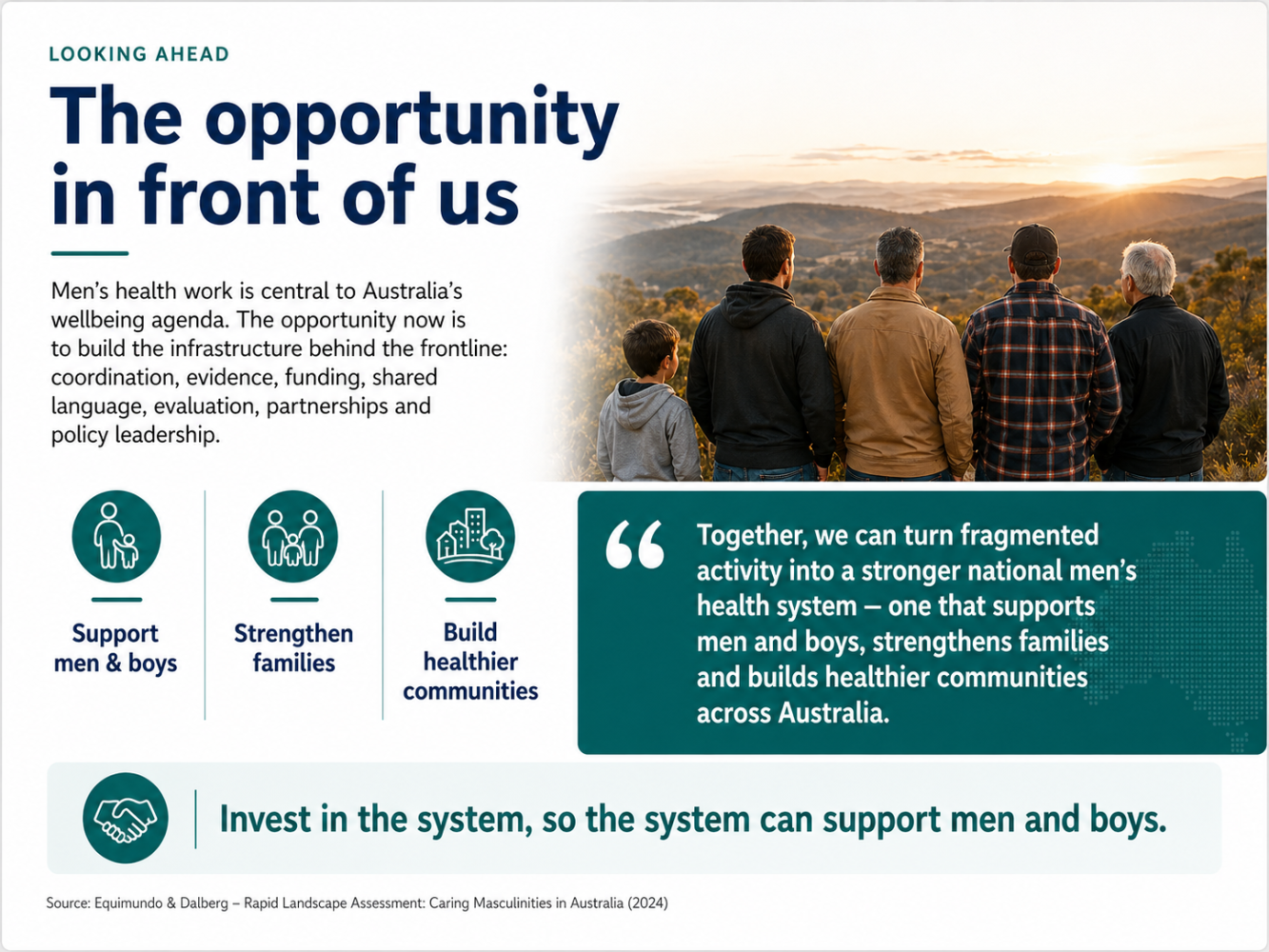
The Equimundo report gives us a timely opportunity to say something clearly: men’s health work is not peripheral to Australia’s wellbeing agenda. It is central.
But if we want the sector to deliver national outcomes, we need to invest in the sector itself.
We need the infrastructure behind the frontline: coordination, evidence, funding, shared language, evaluation, partnerships and policy leadership.
That is what I hear from our members.
That is what I see at Mentoring Men.
And that is the opportunity now in front of AMHF: to help turn fragmented activity into a stronger national men’s health system — one capable of supporting men and boys, strengthening families, and building healthier communities across Australia.